Trend updates, practical tips, and fresh ideas for your business
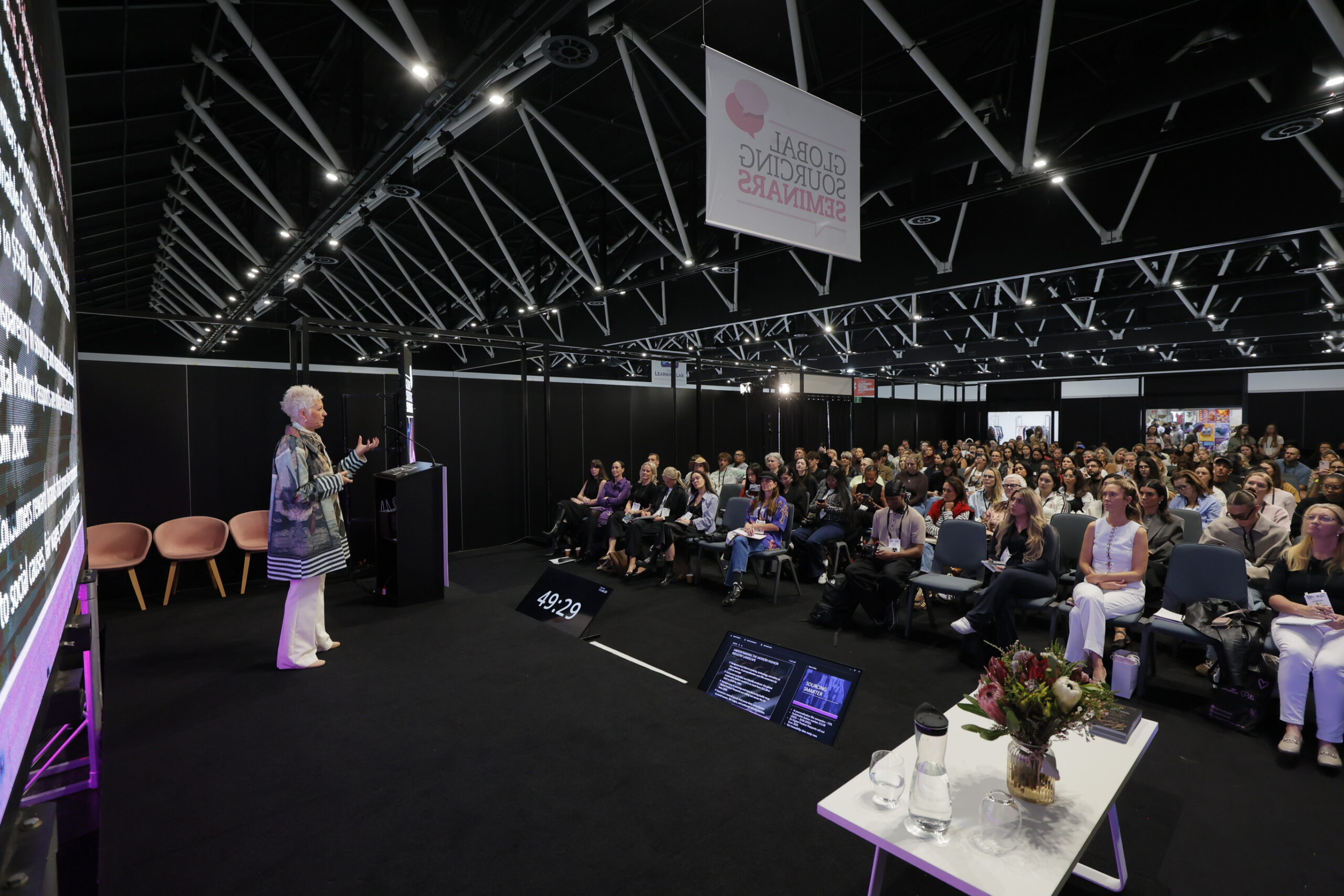
The Global Sourcing Seminar Series takes place across the three days of the event.
Fast, high impact inspiration. These one hour, TED style sessions located on the Expo Floor, offer quick, digestible insights from industry specialists. Ideal for attendees who want to stay inspired while exploring the Expo, the seminars provide trend updates, practical tips, and fresh ideas you can apply immediately. Each session is one hour in duration and tickets cost $40 +gst per session.
Melbourne 2026 Program
10:30 – 11:30am
Sourcing & Sustainability for Fashion Entrepreneurs (Part 1)
Presented by Jude Kingston, Founder & Global Fashion Strategist, International Speaker | Fashion Business Expert | Executive Mentor | Mental Health Advocate

The fashion industry is changing faster than ever before. Consumers are demanding greater transparency, governments are introducing new sustainability regulations, and brands are expected to deliver products that are not only beautifully designed but ethically and responsibly produced.
Session Overview
The fashion industry is changing faster than ever before. Consumers are demanding greater transparency, governments are introducing new sustainability regulations, and brands are expected to deliver products that are not only beautifully designed but ethically and responsibly produced.
Whether you’re launching your first collection or scaling an established label, understanding how to source strategically and build sustainability into your business is no longer optional—it’s essential. During this session you’ll gain practical insights into:
The changing global fashion landscape and what it means for your business; How to source manufacturers and suppliers with confidence; Understanding ethical sourcing, transparency and supply chain traceability; Developing professional Tech Packs and production documentation; Working effectively with manufacturers and the production process; Negotiation – how to tips and insights; Industry terminology and what it means; Understanding MOQs, costing, lead times and quality assurance; Sampling process in detail; Selecting fabrics and trims with sustainability in mind; Colour selection and process ; Local versus offshore manufacturing strategies; International certifications including GOTS, OEKO-TEX®, Fairtrade, Global Recycled Standard (GRS) and B Corp; Logistics, Tariffs, Import Duties; Circular fashion principles including repair, resale, recycling and product longevity ;Preparing your business for Digital Product Passports and evolving global compliance requirements; Avoiding greenwashing while building genuine customer trust; Creating a resilient sourcing strategy that supports both profitability and long-term sustainability.
This seminar provides practical, real-world knowledge you can immediately implement into your own business. (See Part 2 on Day 2)
12:00 – 1:00pm
Best Foot Forward: How Podiatrist Anna Baird Built Bared Footwear Into a Viral Global Brand
Presented by Anna Baird, CEO and Founder, Bared Footwear

Kylie Minogue had the Bared Footwear headquarters spinning around on September 26 after her spectacular pre-game performance at the AFL Grand Final, where she teamed her costumes from Italian luxury brand Dolce & Gabbana with three custom pairs of Bared Footwear’s best-selling Pandion boot.
Session Overview
Kylie Minogue had the Bared Footwear headquarters spinning around on September 26 after her spectacular pre-game performance at the AFL Grand Final, where she teamed her costumes from Italian luxury brand Dolce & Gabbana with three custom pairs of Bared Footwear’s best-selling Pandion boot.
The Kylie coup capped off a breakout year for the unstoppable Aussie shoe brand which was founded by Melbourne podiatrist Anna Baird in 2018. Previously photographed in Bared’s products this year have been influencer Alix Earle, Blackpink’s Jennie Kim, Jennifer Coolidge and Meryl Streep during The Devil Wears Prada 2 press tour. The media exposure has helped boost sales, particularly in the US market, which now accounts for nearly 15 percent of total sales, up 51 percent on 2025, with sales spiking 80 percent over the past six months.
Join this session to learn how Baird scaled a global footwear brand from scratch, how to push through the hard yards of bootstrapping to profitability, the game changing move to China sourcing and sustainable materials, the value of omnichannel customers and how to get sizing right and the importance of a fashion-first marketing strategy.
2:00 – 3:00pm
Making the Future: Australia’s Fashion Industry in a Changing Global Supply Chain
Presented by Marianne Perkovic, Executive Chair, Australian Fashion Council (AFC)

Australia’s fashion industry is at an inflection point. As global sourcing networks evolve and local manufacturing ambitions grow, the choices made now about where we source, how we build, and who we partner with will define the next decade of Australian fashion.
Session Overview
Australia’s fashion industry is at an inflection point. As global sourcing networks evolve and local manufacturing ambitions grow, the choices made now about where we source, how we build, and who we partner with will define the next decade of Australian fashion. AFC Executive Chair Marianne Perkovic opens the 2026 Global Sourcing Expo with a view from the front: the state of Australian fashion, the government’s National Manufacturing Strategy and what it means for the industry, and why Australia’s relationship with its global supply partners has never been more strategically important.
3:30 – 4:30pm
Made in Australia: The Reshoring Movement Gaining Momentum
Presented by Melanie Flintoft, Co-Owner & Creative Director, Silver Fleece; Samantha Van Zyl, CEO, LoomTex; Samantha Delgos, General Manager, Australian Fashion Council, Sarah Lloyd, Creative Director and Founder, Sarah Lloyd

Australia once had a thriving textile, clothing and footwear manufacturing sector, but following the removal of tariffs and quotas from the 1980s, production moved offshore — with an estimated 97 per cent now manufactured overseas. Recent global supply chain disruptions, however, have sparked renewed momentum for rebuilding local capability.
Session Overview
Australia once had a thriving textile, clothing and footwear manufacturing sector, but following the removal of tariffs and quotas from the 1980s, production moved offshore — with an estimated 97 per cent now manufactured overseas. Recent global supply chain disruptions, however, have sparked renewed momentum for rebuilding local capability.
We will hear from Samantha Delgos, the AFC’s General Manager, who has driven the development of the National Manufacturing Strategy, along with Adelaide-based entrepreneur Melanie Flintoft who, together with her husband and business partner Dean Flintoft, rescued the 74 year-old knitting mill Silver Fleece out of liquidation in 2024.
They are joined by Samantha Van Zyl, CEO of LoomTex, a Geelong-based woven textile mill and dye house that was established in 1920 and Sydney-based designer Sarah Lloyd, whose eponymous, nine year old women’s fashion label is 100 percent Australian-made, focussing on classic tailoring, sustainable style, and timeless foundation pieces. Together, the panellists will share practical insights into revitalising heritage manufacturing businesses, the realities of producing onshore, and the opportunities shaping the future of Australian-made textiles.
10:15 – 11:15am
Selling & Scaling for Fashion Entrepreneurs (Part 2)
Presented by Jude Kingston, Founder & Global Fashion Strategist, International Speaker | Fashion Business Expert | Executive Mentor | Mental Health Advocate
Why do some fashion businesses grow profitably while others find their margins shrinking and cash tied up in inventory? The answer is rarely one major decision. Stronger results come from a series of better-connected choices across product development, merchandise planning, buying, margin, inventory and sourcing.
Session Overview
Designing a great product is only the beginning. Building a profitable fashion business requires a clear sales strategy, strong brand positioning, commercial discipline and the systems to scale sustainably.
Today’s most successful fashion businesses combine creativity with data-driven decision making, exceptional customer experiences and diversified sales channels. Whether you’re launching a new label or growing an established brand, understanding how to sell strategically and scale confidently is essential for long-term success.
During this session you’ll gain practical insights into:
Developing a strong commercial fashion business strategy; Building a compelling brand identity and Unique Selling Proposition (USP); Understanding your ideal customer and creating customer-centric experiences; Selling through wholesale, retail, e-commerce and direct-to-consumer (DTC) channels; Creating an omnichannel strategy that delivers a seamless customer journey; The real cost of building your business; Understanding pricing architecture, retail margins and profitability; Key retail performance metrics including Gross Margin, Sell-Through, Stock Turn and Average Order Value (AOV); Customer acquisition, retention and loyalty strategies; Digital marketing, social commerce and AI-powered customer engagement; Scaling through systems, forecasting and operational efficiency; International expansion and entering new markets; Events, partnerships and collaborations; Funding business growth through investment, grants and strategic partnerships; Making data-driven decisions that support profitable, sustainable growth
Build confidence in the commercial language of fashion by understanding key industry terminology and meaning.
11:30am – 12:30pm
The Profit Is in the Process: Turning Better Range and Sourcing Decisions into Fashion Business Growth
Presented by Elizabeth Formosa, Business Advisor & Strategist, Fashion Equipped

Why do some fashion businesses grow profitably while others find their margins shrinking and cash tied up in inventory? The answer is rarely one major decision. Stronger results come from a series of better-connected choices across product development, merchandise planning, buying, margin, inventory and sourcing.
Session Overview
Why do some fashion businesses grow profitably while others find their margins shrinking and cash tied up in inventory? The answer is rarely one major decision. Stronger results come from a series of better-connected choices across product development, merchandise planning, buying, margin, inventory and sourcing.
Drawing on more than 25 years of industry experience, Elizabeth will explore where disconnected decisions quietly cost fashion businesses money—from over-ranged collections and order quantities that are misaligned with demand to sourcing choices made without a clear view of buying budgets, margin targets or the commercial outcomes the range needs to deliver.
Attendees will gain insight into:
- How historical sales data and AI-supported analysis can reveal patterns across styles, sizes and categories—and inform better range, buying and sourcing decisions
- How to evaluate order quantities, lead times and landed costs through a wider commercial lens
- How range architecture creates greater clarity, balance and commercial focus
- Where small improvements across planning and sourcing can unlock stronger profit, cash flow and growth
Designed for fashion founders, product developers, buyers, merchandisers and business leaders, this practical session will provide a clear framework for identifying profit opportunities and making stronger commercial decisions across the product and sourcing process.
1:15 – 2:15pm
Navigating the Increasing ESG Reporting Requirements in Global Trade
Presented by Lawrence Christoffelsz, Founder, Ethical Trade Alliance

The rules of market access are changing. Across the EU, UK, US, Canada and increasingly Australia, the burden of proof is shifting onto the importer. Where an invoice and certificate of origin once sufficed, buyers must now demonstrate that no forced labour sits in their supply chain, quantify the embedded carbon in their goods, and trace inputs well beyond tier 1 to the farm, mine or mill of origin.
Session Overview
The rules of market access are changing. Across the EU, UK, US, Canada and increasingly Australia, the burden of proof is shifting onto the importer. Where an invoice and certificate of origin once sufficed, buyers must now demonstrate that no forced labour sits in their supply chain, quantify the embedded carbon in their goods, and trace inputs well beyond tier 1 to the farm, mine or mill of origin. Digital product passports, mandatory due diligence and border carbon adjustments are moving from proposal to enforcement — and your customer’s compliance obligation quickly becomes your data obligation. Suppliers who cannot answer these questions are already being designed out of procurement decisions.
This session cuts through a dense regulatory landscape to explain what is required, by whom, and on what timeline. It is built for small and medium exporters seeking a proportionate starting point, through to multinationals managing multi-tier supplier networks across several jurisdictions. Attendees will leave understanding the risks of inaction, how to capture traceability and carbon data without rebuilding the business, and where ESG compliance becomes a genuine commercial advantage.
2:30 – 3:30pm
Your Products Aren’t the Problem. Your Visibility Is
Presented by Jenn Donovan, Marketing Strategist & Author

11 marketing strategies that help product businesses get discovered, remembered and recommended — with AI doing the heavy lifting.
Session Overview
11 marketing strategies that help product businesses get discovered, remembered and recommended — with AI doing the heavy lifting.
You can source the best products in the world, but if your ideal customers can’t find you, your marketing isn’t doing its job. In this practical session, Jenn Donovan shares 11 simple, low-cost marketing strategies to help product businesses stand out, attract more customers and stay top of mind.
And here’s the twist… not one of the 11 strategies involve social media. Because in 2026, being visible is about much more than posting online.
You’ll also discover how AI can make each strategy quicker, easier and far more achievable, without losing the human touch, adding more hours or more staff.
You’ll leave with practical ideas you can put into action immediately and a fresh way of thinking about marketing that doesn’t rely on creating another Reel.
3:45 – 4:45pm
Production & Sourcing in the World of AI: How Fashion Founders Can Navigate What’s Next
Presented by Natasa Pitra-Grbic, Creative Director, PITRA

Artificial intelligence is rapidly transforming how fashion founders approach production and sourcing. What began as a tool for content creation is now reshaping supplier discovery, material sourcing, production planning, cost analysis, risk management and supply chain decision-making.
Session Overview
Artificial intelligence is rapidly transforming how fashion founders approach production and sourcing. What began as a tool for content creation is now reshaping supplier discovery, material sourcing, production planning, cost analysis, risk management and supply chain decision-making.
This session explores how founders can move beyond using AI for marketing and begin integrating it into the operational side of their business. Through practical examples from the fashion and creative industries, attendees will discover how AI can support supplier research, evaluate manufacturing options, improve production workflows, strengthen sourcing decisions and identify potential risks earlier in the development process.
Rather than replacing human expertise, AI is emerging as a strategic partner—enhancing efficiency while allowing founders to focus on creativity, innovation, relationships and long-term business growth. The session also explores where human judgement remains essential, particularly in quality, craftsmanship, supplier relationships and ethical decision-making.
10:30 – 11:30am
The Meghan Effect: How to Ride the Influencer Rollercoaster
Presented by Karen Gee, Founder and Creative Director, Karen Gee; Rich Bell, Co-Founder and Marketing Director, ThreeByOne; Julia McCarthy, Founder and Creative Director, Friends with Frank

What happens when one of the world’s most influential figures is photographed wearing your brand? Sales surge, websites strain under demand and inventory can disappear almost overnight.
Session Overview
What happens when one of the world’s most influential figures is photographed wearing your brand? Sales surge, websites strain under demand and inventory can disappear almost overnight.
This session explores the extraordinary impact of influencer-driven commerce through the experiences of Australian brands featured during the Duke and Duchess of Sussex’s recent visit to Australia. Hear firsthand how fashion labels responded to sudden spikes in global attention, managed stock, and fulfilment challenges, and turned viral moments into lasting business growth.
Joining us are Karen Gee, founder of the Karen Gee label – which the Duchess wore for her first appearances on both the 2018 Royal tour of Australia and the South Pacific and this year’s four-day private tour – alongside Rich Bell, co-founder of ThreeByOne’s Rolla’s Jeans, and Julia McCarthy, founder of Friends With Frank. They will share how their brands navigated dramatic increases in traffic, media coverage and sales after products worn by the Duchess sold out within days. They will discuss the systems, logistics and strategies required to capitalise on unexpected demand, as well as key lessons for businesses looking to maximise future influencer opportunities.
12:00 – 1:00pm
The New Sourcing Matchmaker: How AI Search Recommends Suppliers Before You’re Asked
Presented by Ray Pastoors, Organic Search Strategist

In 2026, the traditional buyer’s journey has shifted. Prospective buyers and retailers no longer just “search”, they consult. Long before reaching out to a manufacturer or wholesaler, they use generative AI tools like Google’s AI Mode, Gemini, and ChatGPT to conduct deep-dive research and compare the capabilities of supply chain partners.
Session Overview
In 2026, the traditional buyer’s journey has shifted. Prospective buyers and retailers no longer just “search”, they consult. Long before reaching out to a manufacturer or wholesaler, they use generative AI tools like Google’s AI Mode, Gemini, and ChatGPT to conduct deep-dive research and compare the capabilities of supply chain partners. These AI platforms now act as the ultimate “sourcing matchmaker.” They ingest, synthesise, and interpret vast amounts of data to provide filtered, ready-to-contact recommendations. If your digital signals aren’t optimised for these AI ecosystems, your business is effectively invisible to the modern buyer’s shortlist.
In this session, you’ll learn:
- The New Discovery Phase: How buyers use conversational AI to narrow their search from thousands of potential partners down to a select few.
- The AI Perspective: How AI agents collect and interpret your product data, brand authority, and capabilities to determine if you are a “match” for a buyer’s specific needs.
- Visibility as a Competitive Multiplier: Why leaving your digital presence to chance is a risk you can’t afford.
- How to proactively provide the right signals and content to ensure your brand is not just indexed but recommended by AI.
Don’t wait for buyers to find your website by accident. Learn how to master the new digital sourcing landscape, influence the conversation early, and be the first choice when AI makes the match.
2:00 – 3:00pm
Circular economy for fashion clothing, textiles and footwear? What can these sectors do?
Presented by Dr Shalini Sharma, Director, Krystahl, Australia; ICE&SDGs, India & Global Sustainability Reporting Lead, Harvey Norman

The transition to a circular economy is rapidly reshaping the fashion, textile and footwear industries. As customer expectations, sustainability commitments and supply chain pressures continue to grow, businesses must rethink how products are designed, sourced, used and recovered.
Session Overview
The transition to a circular economy is rapidly reshaping the fashion, textile and footwear industries. As customer expectations, sustainability commitments and supply chain pressures continue to grow, businesses must rethink how products are designed, sourced, used and recovered. This session explores practical actions that brands, retailers and suppliers can take today to reduce waste, improve resource efficiency and unlock new business opportunities. Attendees will gain insights into circular design, responsible sourcing, product stewardship, recycling, reuse and emerging circular business models. The session will also highlight how collaboration platforms such as Krystahl’s Sustainability Exchange™ are helping connect businesses with suppliers of recycled and natural materials, supporting circular procurement and more sustainable supply chains. Learn how leading organisations are transforming sustainability challenges into competitive advantage and long-term value creation.